
Solid-State Cooling for Data Centres: Can New Technologies Reduce AI Infrastructure Costs?
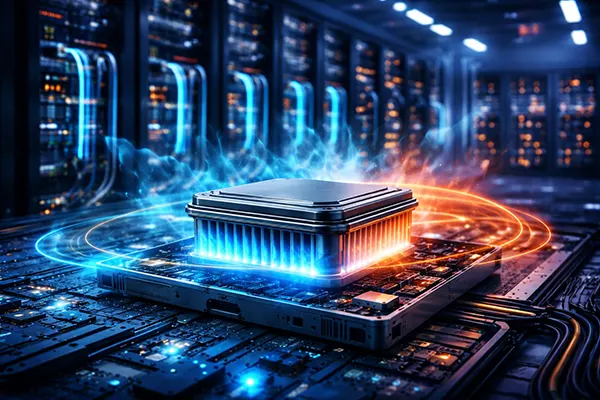
The rapid expansion of artificial intelligence has placed unprecedented pressure on data centre infrastructure, particularly in terms of heat management and energy consumption. Traditional cooling systems, which rely on air conditioning and liquid cooling loops, are increasingly challenged by high-density AI workloads. In response, solid-state cooling technologies are gaining attention as a potential alternative. These systems promise improved efficiency, reduced maintenance, and lower long-term costs, but their real-world impact depends on several technical and economic factors.
How Solid-State Cooling Works in Modern Data Centres
Solid-state cooling refers to a group of technologies that remove heat without moving fluids or mechanical compressors. The most widely discussed approach is thermoelectric cooling, based on the Peltier effect, where an electric current transfers heat from one side of a material to another. This allows for precise temperature control at the component level, making it particularly relevant for AI accelerators and high-performance GPUs.
Unlike traditional HVAC systems, solid-state solutions can be embedded directly into server architecture. This reduces the need for large-scale cooling infrastructure and enables more compact rack designs. In hyperscale data centres, where space and power density are critical, such integration can translate into measurable operational advantages.
Another emerging method involves magnetocaloric and electrocaloric materials, which change temperature under magnetic or electric fields. While still in development, these technologies offer the potential for higher efficiency compared to thermoelectric systems, particularly when scaled across large installations.
Key Technical Advantages and Limitations
One of the main strengths of solid-state cooling is its lack of moving parts. This significantly reduces mechanical failure rates and maintenance requirements, which are major cost drivers in large data centres. Additionally, these systems operate silently and can be controlled with high precision, improving thermal stability for sensitive AI workloads.
However, current thermoelectric systems are less efficient than traditional cooling when applied at large scale. Their coefficient of performance (COP) typically remains lower than that of advanced liquid cooling systems, meaning they may consume more electricity under certain conditions. This limits their immediate adoption in full-scale facilities.
Cost is another factor. Advanced materials used in solid-state cooling modules can be expensive, and manufacturing processes are not yet optimised for mass deployment. As a result, these systems are currently more viable for targeted applications rather than complete data centre replacement.
Impact on Energy Consumption and AI Infrastructure Costs
Cooling accounts for a significant share of total energy usage in data centres, often ranging between 30% and 40%. With AI workloads driving higher thermal output, this proportion is expected to increase. Solid-state cooling offers a different approach by focusing on localised heat removal, which can reduce the need for large-scale cooling systems operating continuously.
By targeting hotspots directly at the chip or module level, these technologies can improve overall energy efficiency. This is particularly relevant for AI clusters where uneven heat distribution is common. Reducing thermal bottlenecks can also enhance hardware performance, allowing processors to operate at higher sustained frequencies without throttling.
From a cost perspective, the benefits are more nuanced. While initial investment in solid-state systems may be higher, operational savings can emerge over time through reduced maintenance, lower downtime, and improved energy utilisation. The total cost of ownership (TCO) becomes the key metric when evaluating their economic viability.
Comparison with Liquid and Air Cooling Systems
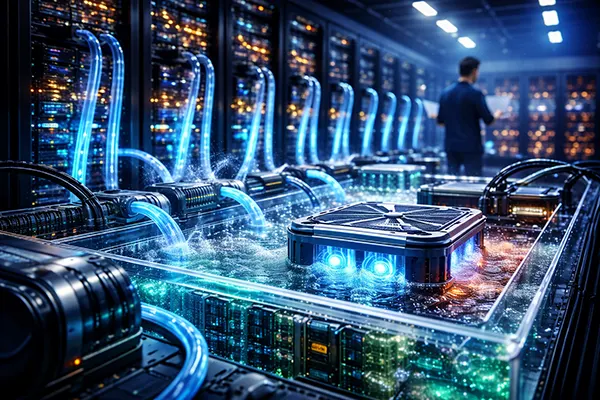
Liquid cooling remains the most efficient solution for high-density AI environments today. Direct-to-chip and immersion cooling systems offer superior heat transfer capabilities and are already widely deployed in large-scale AI data centres. Compared to these methods, solid-state cooling still faces challenges in handling extreme thermal loads.
Air cooling, while simpler and less expensive to install, is increasingly reaching its limits in modern data centres. As rack densities exceed 30–50 kW, traditional airflow-based systems struggle to maintain stable temperatures. In this context, solid-state cooling can serve as a complementary solution, enhancing local thermal management rather than replacing existing systems entirely.
A hybrid approach is emerging as the most realistic scenario. Combining liquid cooling for bulk heat removal with solid-state modules for fine-tuned temperature control can optimise both performance and efficiency. This layered strategy aligns with current trends in modular data centre design.
Future Prospects and Adoption Challenges by 2026
As of 2026, solid-state cooling is transitioning from experimental research to early-stage commercial deployment. Several technology companies and research institutions are actively developing scalable solutions, particularly for edge computing and specialised AI hardware. However, widespread adoption in hyperscale data centres is still limited.
One of the main barriers is scalability. While solid-state systems perform well at small scale, replicating this efficiency across thousands of servers presents engineering challenges. Heat distribution, power management, and integration with existing infrastructure all require further optimisation.
Standardisation is another issue. Unlike traditional cooling systems, which follow well-established industry standards, solid-state technologies lack unified frameworks. This creates uncertainty for operators considering large investments, as compatibility and long-term support remain unclear.
What Data Centre Operators Should Consider
For operators evaluating new cooling strategies, the key question is not whether to replace existing systems entirely, but how to integrate emerging technologies effectively. Solid-state cooling is best viewed as a targeted solution for specific use cases, such as high-density GPU clusters or edge deployments with limited space.
It is also important to assess the maturity of available solutions. Not all technologies marketed as solid-state cooling are equally developed, and performance claims may vary significantly. Pilot projects and controlled testing environments can provide valuable insights before full-scale implementation.
Finally, long-term cost modelling should include not only energy savings but also maintenance, reliability, and hardware lifespan. In AI infrastructure, where downtime can be extremely costly, even marginal improvements in thermal management can justify investment in advanced cooling technologies.