
Manufacturing in Space: Which Materials and Components Make the Most Economic Sense in Orbit?
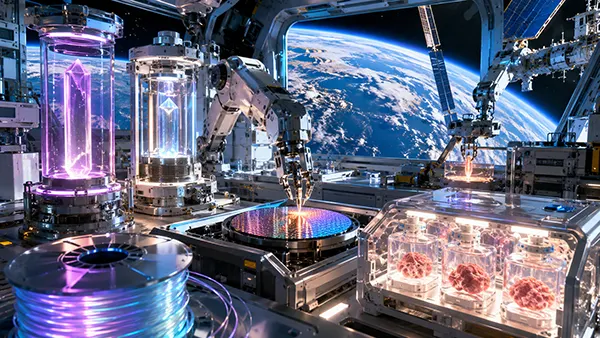
Manufacturing in orbit is moving beyond small scientific experiments and towards processes designed with commercial use in mind. By 2026, pharmaceutical research, semiconductor crystal growth, specialist optical fibres and biomanufacturing have all shown reasons why part of their production may benefit from microgravity. Yet better laboratory results do not automatically mean a profitable business. Sending raw material into orbit, operating equipment remotely and returning finished products to Earth remain expensive and complex. The strongest candidates are therefore products that combine high value with low mass and gain a measurable quality advantage from conditions that are difficult to reproduce on Earth. For some components, the calculation is different: if the finished item will remain in space, producing it there can avoid the cost and design restrictions associated with launching a complete structure from the ground.
Why Some Manufacturing Processes Work Better in Orbit
The most useful feature of low Earth orbit for manufacturing is microgravity. Materials still experience gravity there, but a spacecraft and everything inside it are continuously falling around Earth, producing conditions in which objects behave as though they are nearly weightless. This changes the way liquids, molten substances, crystals and biological materials form. On Earth, heavier material tends to sink, lighter material tends to rise, and warm and cool regions can create fluid movement. These effects can introduce defects or uneven composition. In microgravity, sedimentation and gravity-driven convection are greatly reduced, allowing some materials to form more uniformly.
Crystal growth illustrates why this matters. A crystal produced on Earth can develop imperfections because its components do not remain evenly distributed while it forms. Microgravity can reduce some of those disturbances and give researchers greater control over crystal structure. Similar advantages can apply to certain glasses, semiconductor materials and pharmaceutical compounds. The benefit is not simply that a product is made in space. It must have a property that is meaningfully improved there, such as greater uniformity, fewer defects, better optical performance or a crystal structure that helps researchers formulate a medicine more effectively.
Orbit also provides access to vacuum and allows manufacturing equipment to operate without many of the environmental disturbances found on Earth, although most commercial processes still require carefully controlled chambers rather than exposure directly to space. These conditions make orbit useful for specialised production, but they offer little reason to move ordinary manufacturing away from Earth. Steel beams, standard plastics, consumer electronics and most bulk chemicals can already be produced efficiently in terrestrial factories. Sending tonnes of ordinary raw material into orbit merely to bring a similar product back down would add transport and operational costs without creating enough extra value.
The Economic Test: Value, Mass and a Measurable Quality Gain
A practical orbital product needs to pass several economic tests at once. It should ideally be expensive per kilogram, require relatively little raw material and gain a substantial benefit from microgravity. A few kilograms of a pharmaceutical ingredient, semiconductor material or specialist optical product can potentially represent considerable value. The same launch capacity filled with ordinary construction material would be much harder to justify. This value-to-mass relationship is one reason commercial attention has concentrated on medicines, advanced crystals, photonics and electronics rather than large quantities of conventional goods.
Return logistics are just as important. A material may perform exceptionally well in microgravity but still fail commercially if it requires a large, fragile or costly return system. Companies developing autonomous re-entry vehicles are therefore an important part of the emerging manufacturing chain. Varda Space Industries, for example, has been using compact spacecraft capable of carrying processing equipment in orbit and returning a capsule to Earth. In 2026, the company also announced work with United Semiconductors aimed at producing semiconductor material in orbit. Such projects are significant because repeatable return capability is necessary before orbital manufacturing can move from occasional experiments to regular production.
There is also an important distinction between products made in space for Earth and products made in space for space. Earth-bound products must justify both the journey up and the journey back. Components intended for satellites, stations or exploration missions do not need to be returned. Their economic advantage can instead come from reducing launch volume, avoiding the need to carry numerous spare parts or enabling structures to be assembled after launch. As a result, the most commercially sensible material is not always the one with the highest market price. The answer depends on where the finished product will be used and which transport costs its production can remove.
The Strongest Candidates for Production in Microgravity
Pharmaceutical crystals currently have one of the clearest links between microgravity research and practical benefits on Earth. Protein and drug crystals can form differently when sedimentation and convection are reduced, giving researchers more uniform material and better information about how a medicine behaves. Work carried out on the International Space Station with Merck contributed to research behind a subcutaneous formulation of pembrolizumab, the active ingredient in Keytruda. The important point is that the commercial medicine was not simply manufactured in orbit and shipped to hospitals. Space research helped scientists understand crystal characteristics that could improve formulation on Earth. In 2026, commercial companies are going further by investigating whether selected pharmaceutical processing steps themselves can eventually be performed routinely in orbit.
Semiconductor materials form another increasingly serious candidate. Chip performance depends partly on the quality and consistency of the crystals from which semiconductor devices are made. Gravity-driven movement during crystal growth can contribute to defects and uneven distribution of material. NASA-backed work active in 2026 includes a project involving SpaceWorks and Astral Materials to test silicon semiconductor crystal manufacturing in microgravity using a re-entry system. In Europe, Space Forge demonstrated in May 2026 that its ForgeStar-1 spacecraft could create and control plasma conditions needed for gas-phase crystal growth. These projects do not mean that ordinary computer chips are already being mass-produced in orbit. They show that companies are testing whether space can provide better starting materials for specialised, high-performance devices.
Specialist optical fibre is one of the most developed material examples. ZBLAN is a fluoride glass that can transmit light across wavelengths that are difficult for standard silica fibre, but producing exceptionally clear ZBLAN on Earth is challenging because unwanted crystallisation and separation can occur as the material cools. Microgravity can reduce these effects. During a 2024 International Space Station investigation, Flawless Photonics manufactured about 11.9 kilometres of optical fibre, demonstrating that production can move beyond tiny laboratory samples. The remaining commercial question is whether the resulting performance and consistency are valuable enough to cover transport and orbital operating costs. Because fibre is lightweight and potentially valuable, however, it fits the economic profile of a product that could make sense to return from space.
Biomanufacturing and Specialty Materials: High Potential, Longer Timelines
Human tissues and cells may eventually become another high-value category. Microgravity changes how cells organise because they do not have to support themselves against normal gravity in the same way. In June 2026, astronauts on the International Space Station worked with a bioprinter to produce viable cartilage tissue as part of research into personalised implants. Other current work is examining the expansion of blood stem cells in space for possible therapeutic use. If reliable manufacturing methods emerge, very small quantities of biological material could carry substantial medical value. That makes biomanufacturing economically interesting even though the regulatory, clinical and quality-control requirements are far more demanding than those for an industrial material.
Researchers are also considering nonlinear optical crystals, specialised thin films, colloidal materials and other advanced substances used in photonics, sensing and electronics. These products can be valuable because their performance depends heavily on microscopic structure rather than simply on the amount of material produced. NASA has supported work on crystal-processing methods intended to reduce defects that can arise from sedimentation and convection. In 2026, astronauts were also continuing studies of colloidal crystals and semiconductor materials aboard the International Space Station. Such work helps identify where microgravity creates a repeatable advantage instead of merely producing a scientifically interesting difference.
From a commercial perspective, these categories are at different stages. Pharmaceutical crystallisation has strong evidence that microgravity research can improve understanding of drug formulation, while companies are now testing more direct manufacturing models. Semiconductor crystals have a potentially enormous terrestrial market but still require convincing demonstrations of consistent quality, production speed and cost. ZBLAN fibre has already been produced in multi-kilometre quantities in orbit, although a sustainable commercial supply chain has yet to be established. Bioprinted tissues and stem-cell products could eventually carry extremely high value per unit of mass, but medical approval requirements mean that their route to routine commercial production is likely to be longer.
Components That Make More Sense to Build for Use in Space
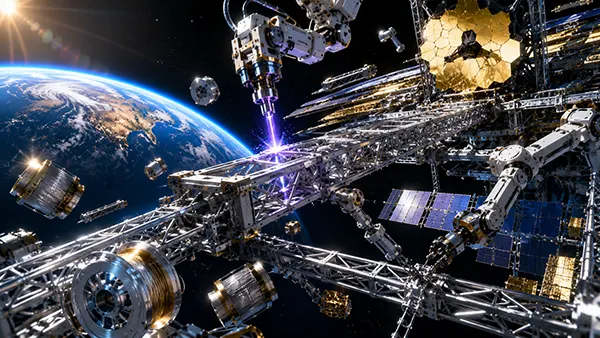
Some of the strongest economic arguments for space manufacturing involve components that never need to come back to Earth. Spacecraft are constrained by the size, shape and mass that a launch vehicle can carry. Large antennas, booms, trusses and other structures must often be folded, segmented or reinforced to survive launch. If part of a structure can instead be manufactured or assembled after reaching orbit, engineers can design around its actual operating environment rather than around the violent journey through the atmosphere. This approach could be particularly useful for large, lightweight structures whose dimensions are more troublesome than the mass of their raw material.
Tools and replacement parts are another practical category. A long-duration station or exploration spacecraft cannot carry unlimited spares for every possible failure. On-demand production can reduce the number of rarely used components stored aboard a mission. Polymer parts are relatively straightforward candidates, while metal manufacturing requires more demanding equipment and safety controls. Recycling could strengthen the economics further by turning packaging, worn components or biological waste into useful feedstock. In 2026, an ESA-supported study examined ways of converting plant waste and packaging materials into nanocellulose and biocomposites that could potentially be used for items including tools and spare parts during future missions.
Repair and joining technologies can also create value without producing a finished product for sale on Earth. Welding, additive manufacturing and robotic assembly could extend the life of satellites or allow modules and structures to be modified after launch. ESA’s advanced-materials and in-orbit manufacturing programme selected a welding demonstration in its 2026 group of projects, reflecting growing interest in maintenance as well as material production. The financial case is different from manufacturing a pharmaceutical crystal: the value comes from avoiding replacement launches, reducing downtime or enabling a spacecraft to operate for longer. For expensive orbital assets, preventing the loss of a functioning system can be worth far more than the raw material used in a repair.
What Is Commercially Realistic in 2026
As of 2026, orbital manufacturing should still be viewed as an emerging industrial field rather than a mature alternative to Earth-based factories. There is clear evidence that microgravity can improve particular processes, and there are now commercial vehicles, manufacturing systems and return capsules designed around those advantages. There is not yet comparable public evidence of routine, large-scale orbital factories achieving stable unit costs across broad product markets. For goods returned to Earth, the strongest near-term model remains small batches of highly valuable material whose quality can be improved enough to justify transport and processing costs.
The shift towards autonomous manufacturing is particularly important. Experiments on the International Space Station have provided decades of scientific knowledge, but commercial production cannot depend indefinitely on astronauts manually operating every process. Dedicated free-flying spacecraft can run automated equipment without occupying crew time, and re-entry capsules can return selected products directly to Earth. Varda’s pharmaceutical work, Space Forge’s semiconductor-related demonstrations and current NASA-supported crystal-manufacturing projects all point in this direction. At the same time, crewed laboratories remain useful for developing techniques, troubleshooting equipment and studying biological processes that are not yet ready for fully automated production.
The materials most likely to justify orbital production therefore share a recognisable profile: they are expensive for their mass, their quality depends strongly on crystal structure, fluid behaviour or cell organisation, and microgravity provides a benefit that cannot be obtained cheaply on Earth. Pharmaceuticals, high-quality semiconductor crystals, specialist optical fibres and selected biomanufactured products fit this description better than conventional bulk materials. For components that stay in space, the priorities change towards reducing launch volume, producing spares when required and building structures that would be awkward to launch fully assembled. The commercial winners will ultimately be determined not by what can be manufactured in orbit, but by what can be produced repeatedly, returned or used reliably, and sold or deployed at a cost that makes the extra journey worthwhile.