
Self-Healing Electronics: Materials That Can Repair Damaged Sensors and Circuits
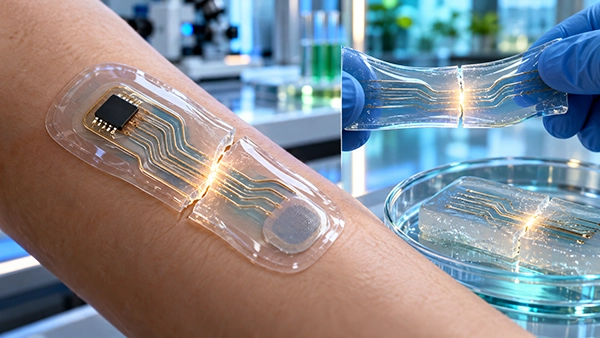
Self-healing electronics are designed to recover from cuts, cracks, repeated stretching and other forms of physical damage that would normally shorten the life of a sensor or conductive circuit. Instead of relying only on rigid metals and conventional plastics, researchers combine flexible polymers, conductive hydrogels, ionogels, carbon materials and liquid metals with chemical structures capable of reconnecting after damage. By 2026, this idea has progressed well beyond simple laboratory films: researchers have demonstrated repairable strain sensors, wearable health monitors, printed conductive structures and even devices in which both the supporting material and sensing function recover after damage. However, self-healing should not be understood as a damaged smartphone processor rebuilding itself. Current systems are much better at repairing soft substrates, electrodes, conductive pathways and sensor layers than complex silicon chips. Their greatest value is therefore emerging in flexible electronics, electronic skin, medical wearables and other devices that regularly bend, stretch or come into direct contact with the body.
What Self-Healing Electronics Actually Repair
The need for self-healing materials comes from a basic weakness of flexible electronics: movement creates wear. A sensor attached to a wrist may bend thousands of times, an electronic skin may repeatedly stretch with a joint, and a soft robotic component may be compressed or twisted throughout its working life. Tiny cracks can gradually develop inside electrodes, conductive tracks or supporting layers. These defects may initially cause only a small change in electrical resistance, but continued use can widen them until the conductive path breaks completely. Accidental cuts and punctures create the same problem much more quickly. A conventional circuit generally requires replacement or an external repair once this happens, whereas a self-healing material is designed to restore contact between the damaged surfaces and recover at least part of its original mechanical and electrical behaviour.
Researchers generally distinguish between intrinsic and extrinsic healing. Intrinsic materials contain reversible interactions throughout the material itself. When damaged surfaces are brought back into contact, molecular bonds can form again and reconnect the structure. Hydrogen bonds, ionic interactions, metal coordination and reversible covalent bonds are among the approaches currently used. Because the repair mechanism is built into the material, intrinsic systems can potentially heal more than once. Extrinsic designs work differently. They contain small capsules or internal channels filled with a repair agent. A crack breaks a capsule or channel, releasing material that fills the damaged area and hardens. This can provide an effective local repair, but a particular capsule normally cannot release its contents a second time after it has already been used.
A successful electronic repair involves more than making a visible cut disappear. Ideally, three things need to recover. The material should regain enough mechanical strength to resist further tearing, the conductive network should reconnect so that current can pass through it again, and the sensor should return to an acceptable level of measurement accuracy. These stages do not always happen equally well. A polymer can close a cut while its electrical resistance remains higher than before, or conductivity can return even though the repaired region is mechanically weaker. Healing conditions also vary considerably. Some materials work at room temperature once the cut surfaces are placed together, while others require mild heating, pressure, light, moisture or another external stimulus. For that reason, a reported healing percentage is meaningful only when the temperature, healing time and measurement method are also considered.
The Main Materials Behind Self-Repair
Self-healing polymers and elastomers form the structural basis of many repairable electronic devices. Unlike conventional permanently cross-linked plastics, these materials contain selected molecular connections that can separate and form again. Hydrogen bonds are widely used because they can reconnect without extreme conditions, while disulphide bonds can exchange positions within a polymer network and help a damaged structure reorganise itself. Other materials use reversible chemical reactions or several types of bonding simultaneously. Designers must balance mobility and strength: molecular chains need enough freedom to reconnect across a damaged area, but a material that is too mobile may become soft, creep out of shape or provide poor support for electronic components. Recent research therefore increasingly combines several bonding mechanisms rather than relying on one form of interaction alone.
Conductive hydrogels are particularly important for wearable sensors because their soft, water-rich structure can behave more like human tissue than conventional electronics. Electrical signals can travel through them using dissolved ions, making them suitable for pressure, strain and physiological sensing. If the polymer network contains reversible bonds, two freshly cut hydrogel surfaces can reconnect and restore both the physical structure and ion-conducting path. Their main weakness is water loss: an ordinary hydrogel may dry out during extended use, changing its mechanical and electrical properties. Ionogels address part of this problem by retaining an ionic liquid inside a polymer network rather than depending mainly on water. In 2026, both material families remain active areas of sensor research because they combine softness, conductivity and repairability in a single layer.
Liquid metals provide another route to circuits that tolerate damage. Gallium-based alloys are electrically conductive while remaining liquid around normal operating temperatures, so they can deform in ways that solid copper tracks cannot. When confined inside suitable elastomers or microchannels, liquid metal can maintain electrical contact during substantial stretching and can sometimes reconnect after a channel or conductor has been mechanically disrupted. Researchers also combine liquid metal droplets with polymers, carbon nanotubes, graphene or metallic particles to build conductive composites. These designs are attractive for soft interconnects and strain sensors, although encapsulation is essential because the conductive material must remain in the intended circuit geometry. In practice, the most promising devices often combine a self-healing outer polymer with a conductive component that can also recover or reorganise after mechanical damage.
What These Materials Can Already Do in 2026
One of the clearest signs of progress is the transition from isolated material samples to integrated wearable devices. In May 2026, researchers reported a shape-stable self-healing polymer system intended for continuous wireless arterial pulse monitoring. The work addressed an important weakness of soft self-healing polymers: materials that are very mobile can repair efficiently but may slowly deform and lose the precise geometry needed for an integrated circuit. Developing a material that remains conformable against the skin while retaining its shape is therefore as important as achieving a high healing percentage. This reflects a wider change in the field. Researchers are increasingly evaluating whether self-healing materials can support electrodes, wireless components and sensing structures over repeated use rather than simply showing that two cut pieces of polymer can stick together again.
A particularly relevant 2026 development involved a self-powered dual-mode sensor based on a conductive PEDOT:PSS aerogel. The researchers designed the complete device so that its mechanical structure and conductivity could recover following damage, rather than limiting healing to an inactive supporting layer. The sensor was capable of separating temperature and pressure information and used thermoelectric voltage for self-powered pressure sensing. According to the study, its sensing performance could be restored even after repeated damage and healing cycles. This type of work matters because functional recovery is a stricter test than visual repair. A sensor that closes a crack but produces a permanently altered signal is of limited practical value. Full-device studies therefore provide a better indication of how self-healing electronics might eventually operate outside controlled material tests.
Manufacturing methods are developing alongside the materials. A Scientific Reports study published in January 2026 described a photocurable polycaprolactone-based composite that combined 3D printability, electrical conductivity and self-healing behaviour. Graphene was incorporated to create conductive versions of the material. At 6% graphene content, the researchers reported electrical conductivity of 0.17 S/m and a self-healing efficiency of 81% within four hours. Their healing tests used controlled conditions including a magnetic field and a temperature of 40°C, which is an important reminder that laboratory healing figures should not automatically be interpreted as room-temperature autonomous repair. The team nevertheless demonstrated printed conductive circuits and functional structures, showing how repairable materials could eventually be shaped directly into customised electronic components rather than being added only as coatings after manufacturing.
Real Sensor and Circuit Examples
Flexible strain sensors provide some of the most practical test cases because they experience exactly the repeated deformation that causes conventional conductive films to fail. Research published in June 2026 described a biodegradable waterborne polyurethane containing both quadruple hydrogen bonding and disulphide bonds. The researchers reported a self-healing efficiency of 71.8%. They used the polymer with carbon nanotubes on hemp fabric to create a flexible strain sensor capable of detecting deformation over a strain range exceeding 124%. The design is notable because it addresses two problems at once: mechanical damage during use and the environmental burden created when short-lived flexible electronics are discarded. The work remains a research demonstration rather than a mass-produced wearable, but it shows how self-healing chemistry can be combined with natural fibres and conductive carbon materials without abandoning the basic sensing function.
Another 2026 study developed a fully bio-based polyester elastomer using several reversible interactions, including disulphide, hydrogen and other dynamic bonds. The material reached a reported healing efficiency of up to 93% when repaired at 60°C. A flexible sensor made from it also maintained stable electrical output through 5,000 cycles at 80% strain under a temperature of −5°C. Those figures demonstrate why researchers increasingly assess more than a single cut-and-repair event. Real wearable and industrial sensors may face cold conditions, repeated bending, sweat, impact and long periods under tension. A material that heals once but rapidly develops fatigue damage afterwards would provide little advantage. Repeated-cycle testing therefore offers a more realistic measure of whether repairability can translate into a longer useful service life.
Liquid-metal circuits provide a complementary example. Research published in 2024 used self-healing polymer blends based on reversible Diels–Alder chemistry to encapsulate stretchable liquid-metal circuits. The polymer blends achieved up to 96% self-healing at room temperature under the reported conditions, while strain sensors made with the encapsulated circuits recovered around 90% of their electromechanical response after damage and healing cycles. The importance of this design lies in repairing two related elements together: the polymer protects and supports the device, while the liquid conductor accommodates stretching without behaving like a brittle metal track. Gallium-based liquid metals continue to attract attention for this reason. Their combination of high electrical conductivity and liquid-state deformability makes them particularly suitable for soft circuits, although controlling leakage, interfaces and long-term stability remains essential.
Why Self-Healing Electronics Still Need More Development
The largest challenge is the compromise between healing speed, strength and electrical performance. A very soft polymer allows damaged molecular chains to move towards each other easily, which can improve healing, but the same mobility may reduce mechanical strength or allow a circuit to deform permanently. Increasing the number of strong cross-links can solve the strength problem while making molecular movement more difficult and slowing repair. Adding carbon nanotubes, graphene or metal particles can improve conductivity, yet these fillers can also restrict polymer movement or create weak internal interfaces. Current research therefore focuses heavily on multi-component materials in which different parts perform different roles. There is no single self-healing formulation that provides the highest conductivity, fastest repair, greatest durability and easiest manufacturing at the same time.
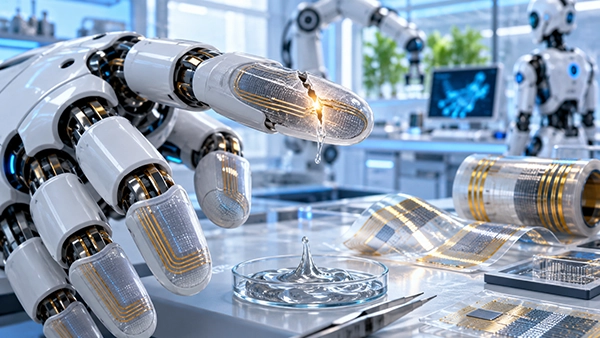
A second limitation is that an electronic device contains much more than a stretchable conductor. Sensors may also include semiconductor components, antennas, connectors, insulating layers, power sources and control electronics. Making the polymer around these components repairable does not make a cracked silicon chip self-healing. Researchers must also ensure that repaired electrical tracks reconnect in the correct place without forming unwanted conductive bridges. For sensors, calibration introduces another difficulty: resistance or capacitance after healing must remain sufficiently close to the original value for measurements to remain reliable. As a result, the phrase full-device self-healing is still used much less often than self-healing material. Research in 2026 shows that full functional recovery is becoming more realistic for relatively simple soft sensors, but highly integrated conventional electronics remain a much harder problem.
Practical adoption will also depend on ageing, safety, cost and sustainability. Water-based hydrogels may dehydrate, some conductive fillers are expensive, and liquid metals require dependable containment. Repeated exposure to sweat, ultraviolet light, temperature changes and cleaning can alter a material even when it has never been cut. Biomedical devices face additional requirements because every material touching the skin must be assessed for biocompatibility and stable long-term performance. Sustainability claims require similar care. Extending a device’s working life can reduce replacement waste, but a self-healing product is not automatically environmentally preferable if its repair chemistry makes recycling difficult. This is why current work on biodegradable polymers, bio-based elastomers, reprocessable networks and repairable conductive composites is significant: the aim is increasingly to combine durability with a more manageable end of life.
Where Self-Healing Electronics Are Heading
The most realistic near-term uses are devices in which softness and repeated movement are unavoidable. Wearable health sensors, electronic skin, rehabilitation equipment, soft robotic systems and human-machine interfaces all fit this description. A conventional rigid conductor attached to a moving body is vulnerable to fatigue, whereas a repairable elastomer or hydrogel can absorb deformation and potentially recover from small cracks before they cause complete failure. Medical monitoring is particularly attractive because a sensor that remains functional for longer could reduce replacement frequency and interruptions in measurement. The 2026 research on arterial pulse monitoring, repairable strain sensors and conductive hydrogel systems indicates that development is moving towards devices that combine comfortable skin contact with stable electrical behaviour rather than treating softness, conductivity and repairability as separate goals.
Manufacturing is likely to influence progress just as strongly as chemistry. Photopolymerisation and other forms of 3D printing make it possible to shape functional polymers into complex structures and to place conductive regions where they are required. Printed electronics could eventually allow repairable sensors, interconnects and protective layers to be produced as integrated structures instead of assembling many unrelated materials afterwards. Liquid-metal circuits offer another route because channels can be formed inside soft polymers and then filled with a conductor that remains deformable during use. The long-term goal is not simply a material that closes a cut, but an electronic architecture designed from the beginning so that mechanical repair also reconnects the electrical path and restores predictable device behaviour.
As of 2026, self-healing electronics should therefore be viewed as a rapidly developing branch of flexible materials research rather than as a universal replacement for conventional electronics. The strongest evidence is currently found in soft sensors, conductive polymers, hydrogels, ionogels, repairable encapsulation and liquid-metal interconnects. Laboratory studies have demonstrated healing efficiencies above 90% in selected materials, repeated recovery of sensing behaviour and the fabrication of conductive structures that can regain function after damage. At the same time, healing conditions, durability and device complexity vary widely between studies. The technology becomes most convincing when researchers report not only that a material joins together again, but also how quickly it heals, under what conditions, how much strength returns, whether electrical performance is restored and how the repaired device behaves after many additional cycles of use.