
Battery-Free Soft Robots: How Daily Temperature Changes Power Autonomous Movement
Robots normally need batteries, electrical connections or an external supply of compressed air to move. Yet a new generation of soft machines is beginning to operate without any of these conventional power sources. Researchers have demonstrated that ordinary changes in temperature between day and night can provide enough energy to activate flexible robotic mechanisms and even produce movement. A study published in Nature Communications in September 2026 demonstrated a system that collects environmental heat, converts it into air pressure and releases the stored energy when needed. Instead of requiring constant electricity, these robots use the natural heating and cooling cycle of their surroundings. Although the technology remains experimental, it offers a different approach to building machines that could eventually operate in remote locations with little human intervention.
How Soft Robots Turn Daily Temperature Changes into Movement
Traditional robots are generally built around rigid components, electric motors and carefully controlled joints. Soft robots take a different approach. Their moving parts can bend, stretch, inflate or change shape, often using flexible materials such as silicone, rubber and specialised polymers. This makes them particularly interesting for situations where rigid machinery would struggle to interact safely with delicate objects or irregular surfaces. Some soft robots move by pumping air into chambers inside their bodies, causing individual sections to expand or contract. The difficulty is supplying that air without attaching the robot to a compressor or carrying a heavy power source. Researchers have therefore been investigating ways to collect useful energy directly from the surrounding environment.
Daily temperature fluctuations provide one possible solution because the environment naturally heats and cools over a predictable cycle. Sunlight raises the temperature of exposed surfaces during the day, while cooler conditions at night allow those surfaces to release heat. These changes may appear insignificant compared with the energy supplied by a motor, but they can still produce useful physical effects. Certain liquids evaporate when warmed, producing vapour and increasing pressure inside a sealed container. When the temperature falls, the vapour can condense and the system can return towards its original state. By carefully controlling these changes, engineers can create a repeating process that collects energy slowly and converts it into a short burst of mechanical activity.
In September 2026, Sergio Picella, Alberto Comoretto, Olivier Vaarkamp and Johannes T. B. Overvelde published research demonstrating this principle in Nature Communications. Their work, associated with AMOLF in the Netherlands and Eindhoven University of Technology, introduced a thermopneumatic system designed for soft robotic devices. Thermopneumatic simply means that heat is used to generate or control air pressure. The researchers developed a mechanism that can collect thermal energy from environmental changes, store it in the form of compressed air and release it to operate flexible actuators. The important advance was not merely showing that warmth could make a material expand. It was demonstrating how naturally available energy could be collected, stored and used at a different time, allowing a soft robotic mechanism to perform useful actions without electronic control.
The Role of Evaporation, Air Pressure and Automatic Valves
The system uses a liquid with a relatively low boiling point, meaning that it evaporates more readily than water at ordinary environmental temperatures. As the energy-harvesting unit warms, the liquid produces additional vapour and increases the pressure available within the connected pneumatic system. The pressure builds gradually rather than immediately producing movement. This distinction matters because environmental temperature changes are usually slow, while a robot may need a much faster action to lift a limb, change position or operate a gripping mechanism. Instead of attempting to match the speed of the surrounding temperature changes, the researchers designed their system to accumulate energy until sufficient pressure becomes available for an activation event.
A specially designed pressure-release valve controls what happens next. The valve remains closed while pressure increases, then opens automatically when a predetermined threshold is reached. Compressed air can then flow into a soft actuator, producing movement without requiring an electronic signal or a motor-driven pump. The valve also incorporates a difference between its opening and closing thresholds, allowing the system to release pressure in a controlled manner rather than repeatedly switching at almost the same pressure. This mechanical behaviour effectively replaces part of the electronic control equipment normally found in robotic systems. The robot does not need a computer to decide when the pressure is sufficient, because the physical design of the valve determines when activation occurs.
Cooling is equally important to making the process repeatable. As the temperature decreases, vapour condenses, pressures change and the energy-harvesting mechanism can begin returning to a condition suitable for another cycle. A successful design must avoid permanently losing the working fluid or exhausting its available air supply after one activation. The researchers therefore focused on recovering the system’s initial operating conditions so that repeated heating and cooling could generate further movement. This approach is different from a robot powered by a disposable gas cartridge, which eventually needs replacing. It also differs from a simple heat-sensitive material that bends while warm and straightens while cool. Here, the collected energy can be stored temporarily and released when a particular mechanical action becomes possible.
What Scientists Demonstrated in Their 2026 Experiments
The research team tested its energy-harvesting mechanism under controlled laboratory conditions and investigated its response to real environmental heating and cooling. One of the most significant results was obtained during an outdoor thermal cycle, when the energy-harvesting system produced 142 activations of a self-oscillating soft actuator. An actuator is the part of a robot responsible for creating movement. In this case, the repeated activity showed that energy collected from naturally occurring temperature changes could support many individual mechanical actions rather than a single response. The result is especially important because outdoor conditions cannot be controlled as precisely as temperatures inside a laboratory. Changes in sunlight, surrounding air temperature and heat loss all influence how quickly sufficient pressure can accumulate.
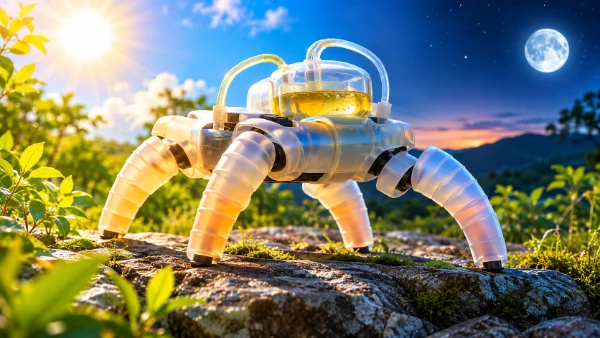
The researchers also built an untethered walking robot powered by an onboard version of their thermopneumatic system. The experimental walker weighed approximately 154 grams and used flexible pneumatic actuators to generate movement. During laboratory testing, a heat gun provided the thermal input needed to demonstrate the mechanism. Following approximately 18 minutes of heating, sufficient pressure accumulated to open the release valve and activate the robot’s moving elements. The walker travelled approximately 40 centimetres, equivalent to around twice its body length. This was not a demonstration of a robot travelling indefinitely through an outdoor environment. Instead, it established that a self-contained thermal energy-harvesting mechanism could generate enough force to move a soft-legged machine without an electrical supply or an external air compressor.
The walking experiment also revealed an important limitation. Although the researchers recorded eight actuator activation cycles, the robot’s forward movement occurred mainly during the initial part of the pressure-release event. As pressure decreased, the remaining force was no longer sufficient to produce the same walking action. This distinction demonstrates why producing mechanical movement and achieving useful locomotion are not exactly the same achievement. A flexible actuator may continue contracting or expanding even when it can no longer move the robot’s entire body. Future designs will need to improve how efficiently pressure is converted into walking motion, particularly if these machines are expected to travel over uneven ground or carry additional equipment.
Why Environmental Conditions Determine How Well These Robots Work
Temperature differences are a useful source of energy, but their availability varies considerably between locations and seasons. A robot exposed to strong sunlight during a warm afternoon may collect energy faster than an identical device operating in a shaded forest or during a cloudy winter day. The temperature of the energy-harvesting unit also depends on its colour, surface material, exposure to wind and contact with the ground. Darker surfaces can absorb more sunlight, while insulation may help retain heat during the pressure-building stage. However, retaining too much heat can also delay cooling and prevent the next cycle from beginning. Successful operation therefore requires a balance between collecting thermal energy and allowing the mechanism to recover.
The 2026 study included a mathematical model to examine how the proposed system might behave under different environmental conditions around the world. The findings suggested that the underlying approach could be relevant across a wide geographical range, provided that sufficient sunlight and suitable ambient temperatures are available. This does not mean that the tested robot can already function reliably in every climate. The amount of usable energy depends on local weather, the design of the heat-collecting components and the pressure required by the actuator. Locations with large differences between daytime and night-time temperatures may offer advantages, but strong solar heating can also create useful temperature changes even when the surrounding air remains relatively stable.
Another consideration is that the robot must collect energy at one rate and consume it at another. Environmental heat usually accumulates over minutes or hours, whereas an individual movement may last only seconds. This makes energy storage a central part of the design rather than an optional feature. A battery performs a similar function in conventional electronics, but the experimental thermal system stores usable energy as pressure instead of electricity. The available energy remains relatively limited, however, and a robot may need to spend a considerable period recharging between movements. For applications requiring continuous high-speed travel, powerful gripping or precise control, conventional electrical systems remain more practical. Temperature-powered soft robots are currently better suited to investigating movement that can occur intermittently when enough energy becomes available.
Where Battery-Free Soft Robotics Could Be Useful in the Future
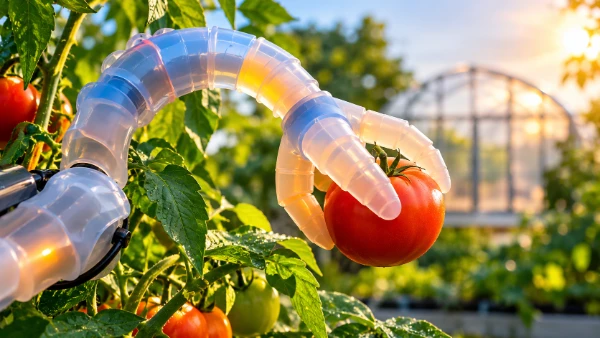
One possible application is environmental monitoring in locations where replacing batteries or maintaining electrical connections would be inconvenient. Remote research stations, natural habitats and agricultural areas often contain equipment that must operate for long periods with limited human attention. Small thermal-powered mechanisms could eventually support simple physical tasks, such as adjusting a protective cover, changing the position of a lightweight component or operating a mechanical indicator. Their usefulness would depend on whether the required task could tolerate infrequent activation and variable operating conditions. Importantly, a completely electronic-free moving mechanism does not automatically provide electronic sensing or wireless communication. Those functions would still need suitable equipment and an independent energy source if they were required.
Architecture is another area where the principle may have practical value. Buildings experience daily changes in sunlight and temperature, and some already use movable shading elements to regulate heat entering through windows. A mechanism that responds to temperature while storing energy for controlled movement might eventually help operate ventilation openings, shading components or adaptive façades without constant electrical input. The researchers specifically identified building-related applications as a possible direction for further development. Such systems would not necessarily resemble walking robots. Their moving parts might instead bend, open or close according to changing environmental conditions. The important shared feature would be the ability to collect thermal energy and convert it into a mechanical response at an appropriate moment.
Soft robotics may also benefit from reducing the number of electrical components required for particular operations. Flexible mechanisms are attractive for handling fragile objects, working in confined spaces and interacting with surroundings that are difficult to predict. However, using ambient heat as an energy source introduces restrictions that would be unacceptable in many existing applications. Medical equipment, for example, generally requires reliable, precisely controlled and timely operation, making uncontrolled environmental temperature cycles unsuitable as a primary power source for most clinical tasks. More realistic near-term possibilities involve simple, low-force movements in non-critical settings. Thermal energy harvesting could also be combined with other technologies, allowing certain mechanical functions to operate passively while more demanding tasks continue to use conventional power supplies.
The Challenges Researchers Must Solve Before Wider Adoption
One major challenge is improving the amount of useful mechanical work produced from relatively small temperature differences. The laboratory walker required substantial heating to demonstrate locomotion, and the test conditions were more favourable than those available during many ordinary outdoor days. Future versions will need to operate effectively with lower thermal inputs, smaller pressure differences and less wasted energy. Researchers have suggested possible improvements to valve opening thresholds, air reservoirs and materials that absorb sunlight. Better component designs could increase the number of useful actions produced during one heating cycle. Reducing the pressure needed for movement may also make the system suitable for smaller or lighter robots, although the available force would still need to match the task being performed.
Long-term reliability presents another difficulty. A robot intended to operate without regular human maintenance must survive repeated temperature changes, environmental exposure and mechanical movement. Flexible components can become damaged through repeated bending, while valves and seals may develop leaks or suffer changes in performance. The 2026 researchers also observed a gradual reduction in the amount of energy harvested over repeated cycles, indicating that the process still requires improvement. Engineers must investigate whether working fluids remain safely contained, whether materials maintain their properties and how the system responds to unusually hot or cold weather. A practical outdoor design would need protection against rain, dust and accidental damage without preventing the temperature changes required to generate pressure.
By late 2026, battery-free soft robots powered by daily temperature variations remained an emerging research technology rather than a commercially established alternative to electrically driven machines. Nevertheless, the experiments demonstrated a useful principle: a robot can collect energy from the environment, store it mechanically and perform movements without conventional batteries or electronic control. The achievement is not simply that heat can produce motion, which has been understood for centuries, but that a compact soft robotic system can organise energy collection, storage and activation into a repeatable operating process. Further advances in materials, pressure control and thermal efficiency will determine whether this approach develops into dependable outdoor equipment. For now, it provides a credible foundation for machines designed to perform modest tasks using energy already available in their surroundings.