
Drones for Emergency Services: Medical Delivery and Search Operations in 2026
Unmanned aerial systems are no longer experimental tools reserved for military or industrial use. By 2026, drones have become an operational asset for emergency services across the UK, the EU and many other regions. Fire brigades, ambulance trusts and search-and-rescue teams deploy them daily to deliver life-saving medical supplies, assess dangerous environments and locate missing people faster than traditional ground units. This shift is driven by measurable results: shorter response times, improved survival rates in time-critical incidents and reduced risk to frontline personnel.
Medical Drone Delivery: From Pilot Projects to Routine Operations
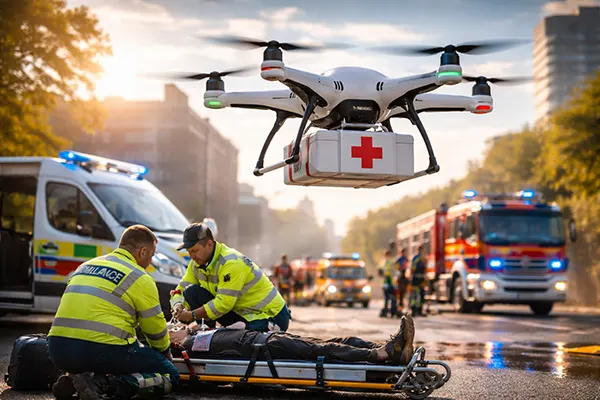
In the United Kingdom, several NHS trusts and regional ambulance services now use drones to transport defibrillators, blood products and urgent medications. Trials conducted in partnership with the Civil Aviation Authority (CAA) and technology providers have demonstrated that drones can reach rural cardiac arrest patients several minutes earlier than road ambulances. In cardiac emergencies, where every minute without defibrillation reduces survival chances by around 7–10%, this time advantage is clinically significant.
Beyond defibrillators, medical drone corridors have been established in parts of Scotland and England to move laboratory samples and blood units between hospitals. In 2024–2025, routine flights over designated airspace proved that drones can maintain cold-chain integrity for temperature-sensitive materials such as O-negative blood. By 2026, these systems operate under structured flight permissions, including Beyond Visual Line of Sight (BVLOS) authorisations, supported by remote pilots and automated traffic management systems.
Urban deployment is also expanding. In dense cities, drones bypass congestion and road closures, delivering antivenom, insulin, emergency antibiotics or specialist trauma equipment directly to paramedic teams on scene. Integrated dispatch software allows control rooms to launch a drone simultaneously with ground units, ensuring that critical supplies are already in the air within seconds of call triage.
Technical Standards, Regulation and Safety in 2026
Regulation remains central to safe integration. In the UK, the CAA’s UAS framework governs operational categories, pilot competency and risk assessments. Emergency service operators typically work within the Specific Category, supported by operational safety cases that address airspace deconfliction, fail-safe systems and cybersecurity. By 2026, Remote ID requirements and improved detect-and-avoid sensors are standard for emergency drones operating in shared airspace.
Redundancy is engineered into medical delivery platforms. Dual batteries, parachute recovery systems and encrypted communication links are now common features. Many aircraft are equipped with real-time telemetry feeds that allow control rooms to monitor battery status, wind conditions and route deviations. If anomalies occur, automatic return-to-home protocols activate without pilot intervention.
Data protection is equally important. When drones transmit video or location data, services must comply with UK GDPR and relevant data governance frameworks. Clear protocols define who can access footage, how long it is stored and how it may be used for incident review or training. These safeguards help maintain public trust while enabling operational transparency.
Drones in Search and Rescue: Faster Location, Lower Risk
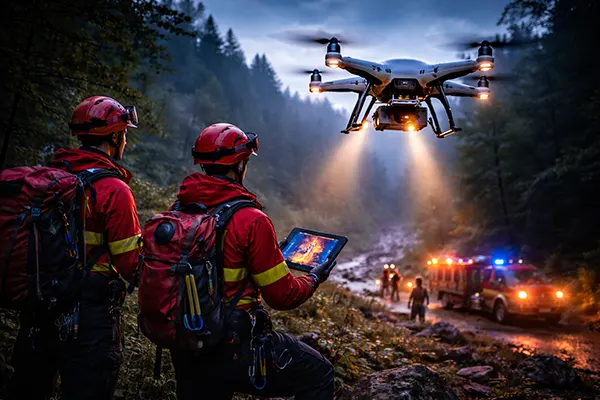
Search and rescue (SAR) teams increasingly rely on drones to cover large or hazardous areas. In mountainous regions of Wales and Scotland, aerial platforms equipped with high-resolution optical cameras and thermal imaging sensors scan terrain that would otherwise require hours of ground searching. Thermal cameras can detect body heat in low-visibility conditions, including at night or through light vegetation, significantly narrowing search zones.
Coastal and flood response operations also benefit. During severe weather events, drones assess flooded neighbourhoods, identify stranded individuals and map safe access routes for rescue boats or high-clearance vehicles. Because they can hover and manoeuvre in confined spaces, they provide situational awareness without exposing personnel to unstable structures or contaminated water.
Urban search following building collapses or industrial incidents presents additional challenges. Compact drones can enter partially damaged structures, transmitting live video to incident commanders. This allows structural engineers and rescue coordinators to evaluate risks before committing crews inside, reducing the likelihood of secondary injuries.
Artificial Intelligence and Data Integration in SAR Missions
By 2026, artificial intelligence plays a practical role in search missions. Machine vision algorithms can analyse live video feeds to detect human shapes, clothing contrasts or movement patterns. Rather than replacing trained observers, these tools act as force multipliers, flagging potential points of interest that operators then verify.
Geospatial integration is another development. Drone imagery can be overlaid on digital mapping systems used by police and fire services. Search grids, last-known-position data from mobile devices and terrain models are combined into a single operational dashboard. This integration improves coordination between air and ground units and reduces duplication of effort.
Importantly, AI-assisted systems are subject to validation and human oversight. False positives remain possible, particularly in complex environments. Operational protocols therefore require final decision-making to remain with trained personnel, ensuring accountability and preventing overreliance on automated outputs.
Operational Challenges and the Road Ahead
Despite progress, challenges remain. Weather limitations still restrict flight in high winds, heavy rain or icing conditions. Battery endurance, although improved, typically allows 30–60 minutes of flight depending on payload and environment. Emergency planners must therefore maintain hybrid models, where drones complement rather than replace helicopters and ground teams.
Airspace integration is another ongoing issue. As commercial drone use grows, emergency services must coordinate with air traffic control, police aviation units and other operators. The development of unified unmanned traffic management (UTM) systems across the UK and Europe aims to provide real-time visibility of all active drones, reducing collision risk and improving route planning.
Funding and training also shape implementation. Procuring aircraft is only part of the equation; agencies must invest in certified pilots, maintenance programmes and secure data infrastructure. By 2026, many services have created dedicated drone units with clearly defined standard operating procedures and continuous professional development requirements.
Future Developments: What to Expect Beyond 2026
Hydrogen fuel cells and next-generation battery chemistries are under active testing, with the potential to extend flight times significantly. Longer endurance would enable broader rural coverage and sustained overwatch during prolonged incidents. Autonomous docking stations, positioned on hospital roofs or fire stations, are being trialled to allow rapid redeployment without manual battery swaps.
Medical payload innovation is advancing as well. Smart delivery boxes can now monitor temperature, vibration and chain-of-custody data in real time. In critical care scenarios, future systems may carry compact diagnostic devices capable of transmitting patient data to clinicians before paramedics arrive.
Public acceptance will remain essential. Transparent communication about safety standards, privacy protections and measurable benefits is crucial to sustaining support. When implemented responsibly, drones provide emergency services with a practical, evidence-based tool that improves response efficiency and helps save lives without increasing risk to those on the front line.