
Bacterial Biofilms for Water Cleaning: A New Generation of Membrane Bioreactors
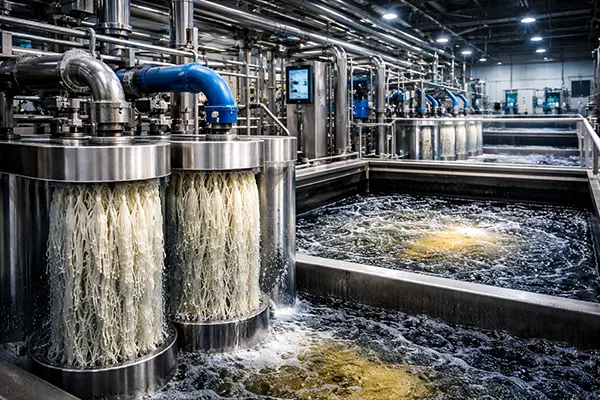
Biofilms are not just “slime” on wet surfaces; they are organised microbial communities that can be engineered to solve real water-quality problems. When a biofilm is paired with a membrane separation step, you get a compact system that can simultaneously drive biological conversions (such as nitrogen removal) and deliver a consistently clear effluent. In 2026, the main conversation is no longer whether membrane bioreactors work, but how to make biofilm-assisted designs more reliable, easier to clean, and better aligned with tougher discharge and reuse expectations.
Why biofilms matter in modern membrane bioreactors
In classic activated-sludge treatment, most microorganisms are suspended in the mixed liquor. A biofilm approach deliberately anchors part of the biology on surfaces: carriers, fibres, granules, or membrane-adjacent structures. This matters because attached growth can stabilise key microbial guilds (nitrifiers, denitrifiers, and specialised degraders) and can improve resilience when the influent swings in temperature, load, or carbon availability. The operator is effectively “holding” more biology in the reactor without simply pushing solids concentrations higher.
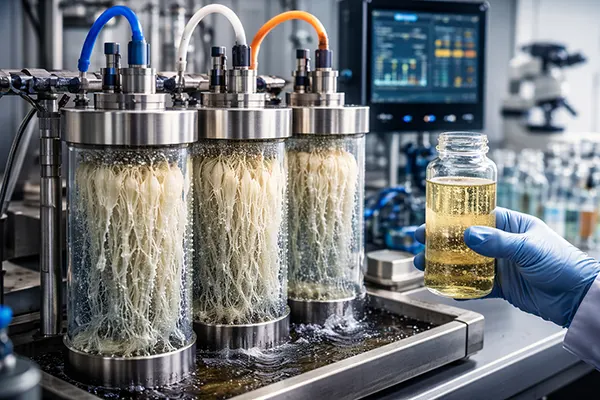
Biofilm-assisted configurations are often discussed under several names. In wastewater contexts, you will see hybrids like biofilm–MBR (BF-MBR), where carriers promote attached growth while a membrane provides final solids separation. In drinking water and polishing applications, a hydrogen-based membrane biofilm reactor (MBfR) is a distinct concept: hydrogen is delivered through gas-permeable membranes to an autotrophic biofilm that reduces contaminants such as nitrate under low-carbon conditions.
From a practical viewpoint, these systems are attractive because they can reduce excess sludge production and create a more controllable biological environment. But the “biofilm advantage” only holds if the system is engineered so that the biofilm does the intended chemistry without turning into a fouling layer that strangles filtration or blocks mass transfer.
MBfR versus BF-MBR: two routes to “new type” performance
MBfR and BF-MBR solve different problems, and mixing them up leads to poor design choices. In an MBfR, the membrane is typically a gas-transfer interface rather than a filtration barrier: hydrogen diffuses through the membrane wall to a biofilm where bacteria use it as an electron donor. This approach is particularly relevant when you need reduction reactions in water with little organic carbon, for example nitrate removal where adding an organic carbon source is undesirable.
BF-MBR designs, by contrast, are filtration-driven membrane bioreactors that add carriers or biofilm-promoting media to improve biological stability and sometimes reduce net sludge yield. Here, the filtration membrane (often microfiltration or ultrafiltration) retains biomass, while the biofilm fraction aims to improve treatment performance or alter the nature of foulants. In real plants, the question becomes whether the carriers genuinely reduce fouling tendency and cleaning frequency, or whether they introduce new operational headaches (media wear, breakage, or uneven mixing).
In 2026, the “new generation” label is earned by systems that address three realities at once: stable conversion of target pollutants, predictable membrane maintenance, and credible monitoring. That means designing for mass transfer (oxygen, hydrogen, substrate), selecting membrane materials and pore structure fit for duty, and building an operating envelope that is tolerant to seasonal change.
Engineering the reactor: membranes, carriers, and controllable mass transfer
A membrane bioreactor is a balance of biology and physics. The membrane delivers effluent quality, but it also creates a bottleneck: if flux is pushed beyond what the foulant load allows, transmembrane pressure rises and the plant spends its life in cleaning mode. Biofilm-enhanced designs do not escape this rule; they just change the foulant profile and the way solids behave near the membrane surface.
Membrane selection is still driven by fundamentals: target effluent quality, required pathogen barrier, chemical tolerance, and cleaning regime. Polymer membranes remain common, while ceramic options appear in harsher duty or where operators want more aggressive cleaning flexibility. What changes in biofilm-assisted setups is the emphasis on surface properties (hydrophilicity, charge, roughness) and module hydraulics, because biofilm growth and extracellular polymeric substances can intensify the “sticky” fraction of fouling if the reactor is not managed carefully.
Carriers and biofilm media can be helpful, but only when their role is explicit. They can provide protected micro-environments for slow-growing microbes, improve nitrification under lower sludge ages, or buffer shock loads. At the same time, carriers can increase shear demands, influence floc size distribution, and alter soluble microbial products—each of which can either improve or worsen filtration. Design needs to treat carriers as a process variable, not a marketing add-on.
Fouling control: what actually works in day-to-day operation
Operators typically experience fouling as a loss of permeability, rising transmembrane pressure, and shorter intervals between cleans. A useful way to think about it is in layers: a reversible layer you can remove with physical methods (air scouring, backwashing, relaxation) and an irreversible fraction that needs chemical cleaning. Biofilm-assisted MBRs still face both mechanisms; the difference is that biofilm and carrier dynamics can shift the balance between reversible cake and more tenacious pore blocking.
The most reliable fouling controls remain fairly “unsexy”: maintain stable aeration (or gas sparging in anaerobic systems), avoid sudden step-changes in flux, and control solids characteristics through the biology rather than chasing pressure spikes after they appear. Where biofilm media is used, the mixing regime has to be tuned so the carriers do not simply grind flocs into a fine colloidal soup that is harder to filter. Temperature management also matters: cold-season viscosity changes and slower kinetics can raise fouling risk if the plant keeps the same flux targets year-round.
In 2026, monitoring is increasingly treated as part of fouling control rather than an afterthought. Plants that succeed typically track permeability trends, cleaning recovery, and indicators that correlate with sticky foulants (for example shifts in soluble microbial products and extracellular polymeric substances proxies). The goal is not to drown the operator in data, but to give early warning that the biology is drifting into a fouling-prone state.
Where these systems fit in 2026: compliance, micropollutants, and water reuse
Across Europe, tightening expectations around nutrient removal and micropollutant control are shaping technology choices. The revised EU Urban Waste Water Treatment Directive (EU) 2024/3019 entered into force on 1 January 2025, bringing stronger requirements and a clearer push towards advanced treatment for certain substances, alongside broader coverage thresholds for agglomerations. For many utilities, this translates into a practical question: how to deliver consistently high effluent quality without exploding energy use and operational complexity.
Biofilm-assisted membrane systems can help in several niches. For nutrient control, stable nitrification and denitrification performance is easier to maintain when the right microbes have protected attachment sites. For low-carbon streams, MBfR concepts are relevant because they deliver an electron donor through a membrane rather than dosing organic carbon, which can reduce unwanted by-products and simplify downstream polishing.
For reuse schemes, membranes are a strong enabling step because they reliably remove suspended solids and a significant fraction of microbes, creating a robust feed for subsequent polishing (such as activated carbon, ozonation, or advanced oxidation, depending on the reuse target). The biofilm component is valuable when it reduces the variability that would otherwise stress the downstream polishing train.
Real-world limits and risks: hydrogen safety, by-products, and maintainability
No “new type” bioreactor is a free lunch. MBfR designs involve hydrogen, which is a clean electron donor but demands disciplined safety engineering: leak management, ventilation, ignition source control, and clear operating procedures. The point is not to make the system scary, but to treat hydrogen like any other industrial gas with well-understood risk controls.
By-products and water chemistry must be addressed honestly. Any biological reduction process can shift alkalinity, influence pH, and change dissolved gas profiles. In nitrate-reduction contexts, controlling intermediate formation and ensuring stable end-products is part of responsible design. For BF-MBRs, the by-product concern is often not a new contaminant, but a change in the nature of dissolved organics that can affect downstream processes or disinfection.
Maintainability is often the make-or-break factor at scale. Plants should be designed for straightforward membrane access, realistic cleaning-in-place routines, and clear criteria for when physical cleaning is no longer enough. If a design demands constant expert intervention to stay stable, it will not survive the staffing reality of most utilities. The best 2026 designs are those that fail gracefully, provide clear signals before performance collapses, and can be brought back with standard operational tools.