
How Quantum Clocks Could Transform Satellite Navigation
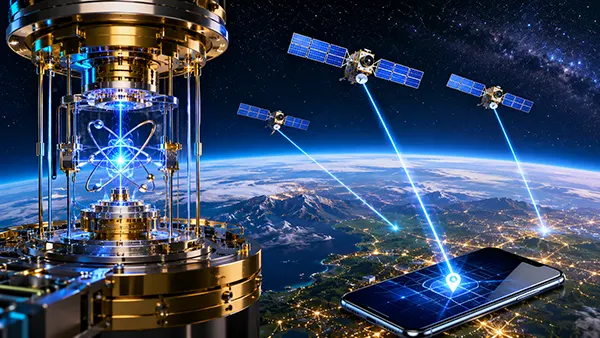
Satellite navigation has become part of everyday life across transport, logistics, aviation, finance and telecommunications. Systems such as GPS, Galileo, GLONASS and BeiDou rely on ultra-precise timing to calculate position and synchronise data between satellites and receivers on Earth. Even a timing error measured in nanoseconds can shift a location estimate by several metres. In 2026, researchers and aerospace companies are investing heavily in quantum clock technology because it promises far greater precision and stability than conventional atomic clocks. These developments may significantly improve navigation accuracy, strengthen resilience against interference and expand the capabilities of autonomous systems.
The Role of Time Precision in Modern Satellite Navigation
Every global navigation satellite system depends on exact timing calculations. Satellites continuously transmit signals containing timestamps generated by onboard atomic clocks. A receiver compares the arrival times of signals from several satellites and calculates its position based on the travel time of radio waves. Since these waves move at the speed of light, even a microscopic timing discrepancy can create substantial navigation errors.
Traditional atomic clocks used in satellites already achieve extremely high precision, but they still experience minor deviations over time. Engineers must regularly correct these drifts through synchronisation procedures conducted from ground stations. As navigation services become more demanding due to autonomous transport, drone delivery networks and precision agriculture, the limitations of current timing systems are becoming more noticeable.
Quantum clocks introduce a different level of measurement stability. These devices use quantum transitions in atoms such as strontium or ytterbium, allowing them to measure time with unprecedented consistency. According to data published by the European Space Agency and the US National Institute of Standards and Technology in 2025 and 2026, advanced optical quantum clocks may lose less than one second over billions of years under laboratory conditions. Such stability could dramatically improve the reliability of positioning systems worldwide.
Why Nanoseconds Matter for Navigation Accuracy
A satellite navigation receiver calculates distance using the time required for a signal to travel from space to Earth. Light travels nearly 30 centimetres in one nanosecond. This means a timing error of only ten nanoseconds can create a positioning error of around three metres. In sectors such as aviation landing systems or autonomous vehicle navigation, this level of inaccuracy may create operational risks.
Quantum clocks can reduce cumulative timing drift far more effectively than existing satellite clocks. Higher timing precision allows satellites to maintain synchronisation for longer periods without external corrections. This improves positioning consistency in dense urban areas, mountainous terrain and remote maritime regions where signal quality is often unstable.
The growing demand for centimetre-level navigation accuracy is one of the main reasons why governments and aerospace manufacturers continue funding quantum timing research. In 2026, several experimental programmes linked to the Galileo system and NASA navigation projects are evaluating optical clock integration for future satellite generations.

How Quantum Clock Technology Could Improve Navigation Systems
One of the most important advantages of quantum clocks is their ability to increase signal reliability. Current satellite systems can be affected by atmospheric interference, electronic noise and clock instability. By reducing internal timing errors, quantum-based systems could generate cleaner and more dependable navigation data for civilian and industrial applications.
Another major benefit involves reduced dependence on ground-based synchronisation infrastructure. Existing navigation satellites require regular calibration from Earth because atomic clocks slowly drift over time. Quantum clocks remain stable for much longer durations, allowing satellites to operate more independently. This could reduce operational costs and improve system resilience during communication outages or cyberattacks.
Quantum timing systems may also support entirely new forms of navigation. Scientists are developing quantum sensors capable of working alongside quantum clocks to create navigation methods that do not rely solely on external satellite signals. Such technologies could become valuable for submarines, spacecraft and military vehicles operating in environments where satellite communication is unavailable or intentionally disrupted.
Potential Benefits for Transport and Autonomous Systems
Autonomous vehicles require extremely accurate positioning to interpret road conditions, lane boundaries and surrounding traffic. Existing GPS accuracy is often insufficient on its own, especially in crowded cities where reflected signals can distort calculations. Quantum-enhanced navigation could significantly improve localisation accuracy for self-driving cars and automated freight systems.
The aviation sector may also benefit from higher precision timing. More accurate navigation signals can improve landing procedures during poor visibility and support safer air traffic management. Airlines and aerospace agencies are already exploring navigation technologies capable of reducing dependence on traditional radar infrastructure.
Shipping and logistics companies are another important area of interest. Modern global supply chains depend on synchronised navigation data across ports, warehouses and transport fleets. Quantum clocks could improve route optimisation and tracking reliability while reducing timing-related errors in international logistics operations.
Challenges Facing Quantum Clock Integration in Satellites
Despite impressive scientific progress, quantum clocks remain difficult to implement on a large scale. Many laboratory prototypes are still too large, fragile or energy-intensive for practical satellite deployment. Engineers must develop compact and durable systems capable of surviving launch conditions, radiation exposure and extreme temperature variations in orbit.
Cost is another major challenge. Optical quantum clocks involve highly specialised components, including ultra-stable lasers and advanced vacuum systems. Manufacturing these devices remains expensive compared with conventional satellite clocks. However, ongoing miniaturisation projects funded by the European Union, the United States, China and Japan are gradually reducing production complexity.
There are also technical questions related to compatibility with existing navigation infrastructure. Current satellite constellations were designed around conventional atomic timing systems. Integrating quantum clocks may require updates to receiver hardware, signal processing standards and satellite communication protocols. Such transitions usually take many years because navigation infrastructure supports billions of connected devices worldwide.
The Future of Quantum Navigation Research
Research activity in this field accelerated considerably between 2024 and 2026. Space agencies and private aerospace firms are testing portable optical clocks designed specifically for orbital use. Some prototypes have already demonstrated successful operation outside controlled laboratory environments, marking an important step toward practical implementation.
Quantum navigation research is not limited to satellite timing alone. Scientists are also exploring quantum accelerometers and gravimeters that could help vehicles determine their location without continuous satellite contact. These systems may eventually complement existing GNSS networks and improve navigation security in regions vulnerable to signal jamming.
Although widespread commercial deployment will likely require several more years of development, the direction of the industry is clear. Quantum clocks represent one of the most promising advances in precision timing technology. Their integration into future navigation systems could improve positioning accuracy, strengthen infrastructure reliability and support the next generation of autonomous transport and aerospace applications.