
Next-Generation Batteries in 2026: Sodium-Ion, Solid-State and Lithium-Sulfur — What’s Actually Market-Ready?
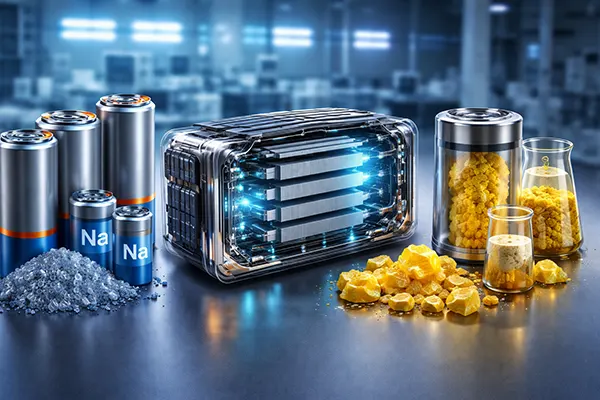
Battery headlines move fast, but real manufacturing moves slower. By 2026, three “next wave” chemistries keep coming up in EV and energy-storage discussions: sodium-ion, solid-state, and lithium-sulfur. Each promises a different advantage—lower cost, higher safety, or higher energy density—but they are not equally mature. This article breaks down what is genuinely ready for wide use, what is still limited to pilots or niche markets, and which engineering hurdles are still blocking mass adoption.
Sodium-Ion Batteries: The First of the New Chemistries to Scale
Sodium-ion batteries are the most commercially “real” of the three options in 2026 because the industry can manufacture them with many familiar lithium-ion production tools. The big attraction is supply-chain resilience: sodium is abundant, widely distributed, and less exposed to the price swings associated with lithium, nickel, and cobalt. That does not automatically make sodium-ion “cheap” in every scenario, but it does make the long-term cost curve easier to predict—especially for large stationary storage projects that need stable pricing more than extreme energy density.
The current trade-off is straightforward: sodium-ion generally offers lower gravimetric energy density than mainstream lithium-ion, so you carry more mass for the same range in a passenger EV. Where it shines is in cold weather, fast charging tolerance, and safety behaviour under abuse. That is why the earliest large deployments are often discussed for battery swapping, commercial fleets, and grid storage—places where volume, reliability, and temperature performance matter more than squeezing every last kilometre from a pack.
By late 2025, the most widely reported industrial signal came from CATL, which publicly indicated sodium-ion systems were moving towards large-scale use through 2026 across multiple sectors, including passenger vehicles, commercial vehicles, battery swapping, and energy storage. In other words: sodium-ion is not just “lab ready”; it has a clear manufacturing roadmap and identified use-cases that match its strengths.
What “Market-Ready” Looks Like for Sodium-Ion in 2026
In practical terms, “market-ready” means predictable volumes, defined specifications, and real customers, even if the first products do not target every car category. Reports around CATL’s 2026 rollout describe sodium-ion cells positioned for multiple real-world deployments, not just prototypes. That matters because scaling batteries is less about one impressive cell and more about repeatable quality, supply contracts, and warranty confidence.
Performance figures discussed in industry reporting for CATL’s sodium-ion line include energy density claims around the mid-100 Wh/kg range and strong low-temperature operation (including sub-zero performance). These figures explain the early focus: grid storage systems can accept lower energy density, while fleets and swapping systems benefit from robust cold-weather behaviour and safety characteristics.
So if you are asking which next-generation chemistry is closest to “normal purchasing decisions” in 2026, sodium-ion is the clear answer. It is not replacing lithium-ion everywhere, but it is moving beyond trials into structured commercial expansion—exactly what a procurement team wants to see before committing to thousands of packs.
Solid-State Batteries: Big Momentum, Still a Manufacturing Challenge
Solid-state batteries are often described as the “endgame” because they aim to replace the flammable liquid electrolyte with a solid material, potentially improving safety and enabling higher energy density. The promise is real, and the technical progress is real—but the gap between “works in a demo” and “produces millions of cells cheaply” remains the core obstacle in 2026.
What is happening in 2026 is best described as industrialisation work: scaling separators, improving yields, stabilising interfaces, and proving long cycle life under automotive duty cycles. Companies like QuantumScape have publicly communicated production scale-up milestones and equipment installation designed to increase output, which is exactly what you would expect at this stage: not mass adoption yet, but a visible shift from lab validation to manufacturing process control.
However, even within the industry there is increasing caution about overly optimistic timelines. Engineers and scientists continue to point out issues such as complex manufacturing, safety control under high-volume conditions, and the difficulty of maintaining consistent ion transport pathways at scale. That is why many solid-state announcements for “mass production soon” are better read as “early production for limited models” rather than immediate mainstream replacement of lithium-ion across the market.
Where Solid-State Is Likely to Appear First (and Why)
The first credible solid-state appearances are likely to be in premium segments or limited-run applications where cost is less sensitive and where manufacturers can manage tighter quality control. Even if a solid-state cell is excellent, its early production lines are expensive and yields can be unpredictable. That combination naturally pushes early supply to high-margin vehicles or specialised applications that can tolerate higher costs.
Another early pathway is hybrid approaches—cells that use semi-solid or “solid-state-like” architectures, but still rely on some liquid or gel components to reduce interface problems. These designs can deliver incremental safety and performance benefits while avoiding the hardest parts of fully solid-state manufacturing. They are not the final vision, but they can be commercially useful stepping stones.
So the honest 2026 message is this: solid-state is progressing, pilot lines are becoming more serious, and some limited commercial products may appear, but large-scale mainstream adoption still depends on manufacturing breakthroughs—especially yield, cost, and consistent long-term performance.
Lithium-Sulfur Batteries: High Potential, Still Mostly Niche
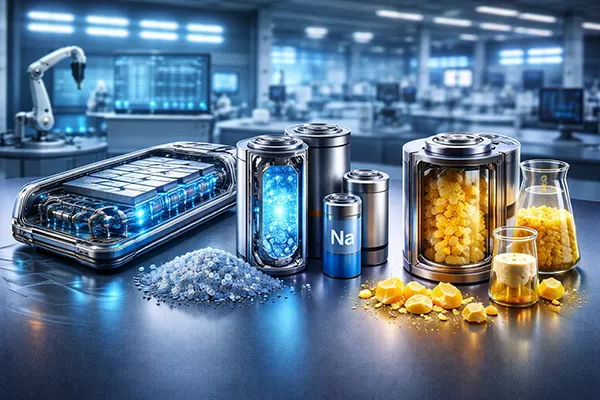
Lithium-sulfur (Li-S) is appealing on paper because sulfur is abundant and the chemistry offers a very high theoretical energy density. If Li-S could be manufactured cheaply with long cycle life, it could reshape long-range aviation, high-end drones, and potentially even EVs. The reality in 2026 is that Li-S remains the least mature of the three for broad markets, mainly because of cycle-life challenges and complex degradation mechanisms.
The biggest technical problem is often described as the “polysulfide shuttle,” where intermediate compounds dissolve and migrate, leading to capacity loss and poor long-term stability. Researchers and companies have made progress using advanced host materials, protective layers, and improved electrolytes, but the long-life, high-cycle requirements of mainstream passenger EVs are still a hard match for Li-S at scale.
Where Li-S is more realistic today is in applications that value extreme energy density more than extremely long cycle life. That includes certain defence, aerospace, and drone use-cases, plus some stationary or backup scenarios where replacement cycles can be planned. Corporate updates from Li-S-focused companies describe commercial deliveries for specific markets and continued expansion plans, which supports the view that Li-S is becoming practical—but selectively, not universally.
What Lithium-Sulfur Can Realistically Do in 2026
By 2026, the strongest Li-S story is not “your next family EV will have it,” but rather “specialised products can benefit from it right now.” Drones and aerospace platforms gain immediate value from lighter packs and higher specific energy, even if the battery will be replaced more frequently than a typical EV pack. That makes Li-S commercially relevant in narrow sectors where performance dominates the cost-of-ownership equation.
The second realistic track is stationary and backup power for niche environments. If a Li-S manufacturer can offer competitive cost per stored kWh and acceptable cycle life for the duty pattern, it can win contracts even without matching lithium-ion durability. This is why some companies discuss energy storage systems, data-centre backup, or space-related markets as near-term targets.
Overall, lithium-sulfur in 2026 is best understood as “commercial in focused segments.” It is no longer purely academic, but it still needs significant improvements in stability, manufacturability, and long-life performance before it can be considered broadly market-ready for mass EV adoption.